

An editorial guide · Denpasar, Bali
Natural supplements for men, explained plainly
NusaSehat is an editorial guide to the vitamins, minerals and botanicals that turn up again and again on men's supplement shelves in Indonesia. We do not sell anything here. We read labels, compare formula patterns, and explain what each ingredient is usually included for, so you can walk into a Denpasar pharmacy or open a marketplace listing and know what you are looking at.
What this site covers
Men's supplement shopping in Indonesia today is mostly about everyday wellness: energy for work, endurance for training, recovery after both, and support as the years add up. That is a broad job, and the market answers it with a wide range of formats. Some products are mineral-first, like zinc with vitamin B6. Others lead with botanicals such as ashwagandha or tongkat ali. Many mix the two. Our job is to help you tell them apart.
We write about four things. Ingredient explainers: what zinc, magnesium, B-complex, vitamin D, omega-3, CoQ10, ashwagandha, maca, tongkat ali and saw palmetto are typically used for in a daily routine. Formula comparisons: how mineral-plus-vitamin products differ from botanical blends, daily multivitamins and more targeted formats. Selection guidance by age, diet and training load. And label reading, so the back of the pack becomes more useful to you than the front.
If you want the short version: start with the Ingredient Guide, then compare formats, then narrow by your own routine. Each page links to the next, and none of them assume you already know the vocabulary.

Why zinc keeps appearing
Zinc is one of the most repeated minerals in men's formulas, and it is not hard to see why. It is a mineral the body uses in many ordinary processes, and it appears in food sources ranging from seafood to eggs to legumes. A product like Standard Process Zinc Chelate sits in a brand's men's lineup alongside botanicals, which tells you something about how formulators think: minerals as a base layer, botanicals as the variable on top.
The practical question is not whether zinc belongs in a formula. It is how much, in what form, and what it is paired with. Nutriwell Tri Zinc + Vit B6 is a tidy local example of the mineral-plus-B-vitamin pattern, sold as a tablet in Indonesian retail. Pairing zinc with B6 is a familiar move because B-complex vitamins are water-soluble and commonly included in daily formulas. You will see the same logic repeated across shelves.
Botanicals: ashwagandha, tongkat ali, maca
Walk through any men's wellness aisle and the botanical names start to blur together. Ashwagandha is often framed around stress and recovery. Standard Process Ashwagandha Forte, for instance, sits in a men's vitality portfolio described as a rejuvenating tonic for stress and immune support. Tongkat ali, a Southeast Asian botanical, appears in products framed around normal body-function support. Standard Process Tongkat Ali is grouped with ashwagandha and zinc in the same brand's men's section.
-
Adaptogen
Ashwagandha
Usually included in formulas framed around stress, rest and everyday recovery. You will see Forte-style products next to mineral entries in the same brand aisle.
-
Root extract
Tongkat ali
A Southeast Asian root that appears in products framed around normal body-function support, often grouped with ashwagandha and zinc in a brand's men's section.
-
Peruvian root
Maca
Commonly used as a filler in blends where formulators want a second botanical alongside the mineral base. Maca often rides next to tribulus in the same mix.
-
Fruit extract
Saw palmetto
Turns up in targeted formulas, sometimes paired with beta-sitosterol and zinc. It is usually the named purpose of the product, not a supporting entry.
Maca and tribulus show up in blends such as NOW Men's Virility Power, which also features epimedium (horny goat weed) and muira puama. You do not need to memorize the names. You need to notice the pattern: traditional botanicals are usually the differentiator between one formula and the next, while minerals and vitamins tend to be the shared foundation. That distinction will help you compare products without getting lost in the label copy.
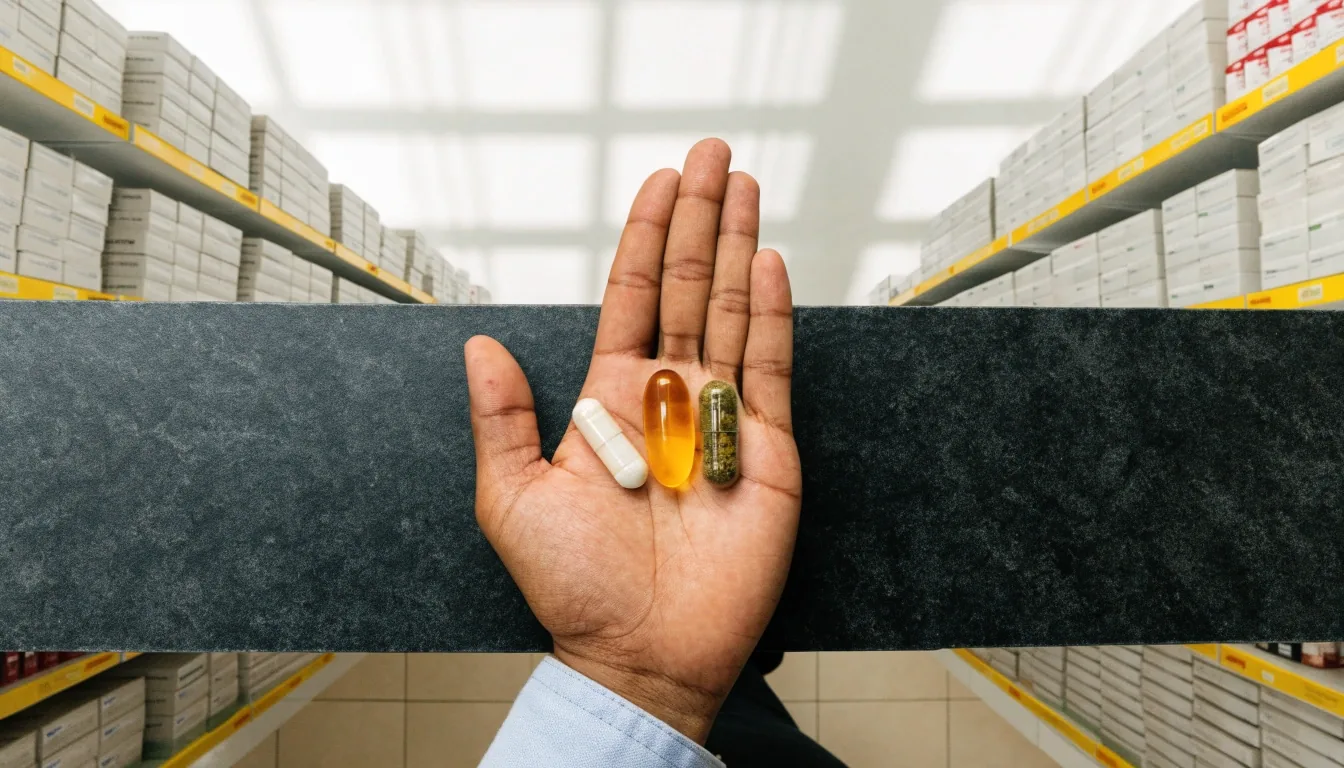
Mineral-plus-vitamin vs. botanical blends
Broadly, men's formulas fall into a few recognizable shapes. None of them is better than another in principle. They answer different questions, and knowing which shape you are holding makes the shelf much easier to read.
| Format shape | Typical contents | What it answers |
|---|---|---|
| Mineral-plus-vitamin daily | Zinc, magnesium, B-complex, sometimes vitamin D. Usually a plain tablet. Nutriwell Tri Zinc + Vit B6 is a local example of the mineral-with-B pattern. | Everyday coverage for the base layer of a routine, easy to read on the back of the pack and easy to slot into a fixed daily habit. |
| Botanical blend | Ashwagandha, tongkat ali, maca, tribulus, epimedium, muira puama and similar roots. NOW Men's Virility Power is a blend example. | A theme rather than a broad gap: the label usually says which idea the product was built around before it lists anything else. |
| Combined targeted format | Saw palmetto and beta-sitosterol with zinc as the mineral anchor, often in softgel form. GNC Men's Prostate Formula fits this shape. | One named area of interest, with the mineral base still carried underneath instead of dropped for the botanical. |
| Daily multivitamin | Broad vitamin and mineral coverage spread across many entries, with botanicals only occasionally added. | Wide nutritional gaps, rather than one focus. Useful when the routine needs breadth more than a theme. |
A daily multivitamin covers broad nutritional gaps; a targeted formula speaks to a specific area of interest. Our Formula Comparisons page lays out the shapes side by side so you can decide which one matches what you actually want from a supplement.
What mainstream retailers tell you
Where the shelf moves
Retail category pages group a wide range of men's items under a single heading. That grouping is itself information: it shows which directions shoppers are already being nudged toward.
Retail category pages are a useful mirror. Walgreens, for example, runs a men's sexual wellness supplements category that also includes prostate-health-oriented products, which shows how mainstream pharmacies group a wide range of men's items under a single navigational heading. The assortment tells you that demand has moved towards targeted formulas rather than one-size-fits-all multivitamins.
Indonesian shelves follow a similar logic, though the specific brands differ. You will find local products like Nutriwell alongside imported names, tablets next to softgels next to capsules. That variety is good for shoppers, provided you can read what is actually inside. Most of our work here is about making that reading easier.
Comfort-focused formulas and careful language
Not every formula is about energy or training. Some are built around everyday comfort. Standard Process UriCo Phytosynergist, for example, sits in the same men's wellness hub as zinc and ashwagandha, and its name signals a comfort-oriented positioning rather than a performance one. Products like this tend to be written about in careful terms by their own manufacturers, and we follow that example.
We avoid cure language, dramatic claims, and before-and-after framing. Supplements are not a substitute for food, sleep, movement or a conversation with a qualified professional when something is actually wrong. What we can do is explain ingredients clearly, describe what a formula is designed to do, and let you decide whether it fits your routine.
How we describe a product
- Plain ingredient names, in the order they appear on the label, with a short note on why they are usually included.
- The format named as sold: tablet, softgel or capsule, because that shapes how the product fits a routine.
- Realistic expectations, with the boundary stated: what a formula is designed for, and what it does not replace.
- No affiliate links and no price talk. If a page makes a claim, we try to say where the claim comes from.
How to use this site
Start where your question is. Each of these four entries assumes you are standing in an aisle or scrolling a listing, not reading a textbook.
- Ingredient Guide If you do not know what an ingredient is, open this first. Zinc, magnesium, B-complex, vitamin D, omega-3, CoQ10 and the common botanicals each get a plain explanation of what they are typically included for in a daily routine. Open the guide
- Formula Comparisons If you are comparing two products, go here. Mineral-plus-vitamin dailies, botanical blends, combined targeted formats and broad multivitamins are laid out side by side so the difference in shape is visible before the difference in wording. Compare patterns
- Choosing by Age and Activity If you know what you want but not which format suits your age, diet or training load, this is the better entry point. It asks about your week before it asks about your shelf. Find a format
- Label Reading Basics Short, and worth ten minutes before you buy anything. It walks through how to read the back of a pack so you can tell what a formula is built around before the front of the box has a chance to persuade you. Read the basics

What we do not do
We do not sell supplements, we do not run affiliate links, and we do not publish prices or promotions. We do not tell you a product will change your body, and we do not use words like cure, treat or prevent. If you are dealing with a health concern, a pharmacist or doctor in Denpasar is a better first stop than any website, ours included.
What we do instead is read labels carefully, group formulas by their actual ingredient patterns, and explain the reasoning behind common combinations. That is a narrower job than it might sound, and it is the one we are set up to do well. Every guide is written in plain English with Indonesian context: brand names you will actually see, formats you can actually buy, and questions that come up in real conversations.
If a guide is wrong
Spotted an outdated brand lineup or a combination we described badly? Tell us. Corrections are the main reason these pages get revised.
Send us a correctionQuestions readers send
The five that come up most often, answered the same way we would answer them by email.
Does NusaSehat sell supplements?
No. NusaSehat is an editorial resource. We explain ingredients and formula patterns; we do not stock, ship, or take payment for any product.
Which ingredients show up most often in men's formulas?
Zinc, magnesium, B-complex vitamins and vitamin D appear frequently as the mineral-and-vitamin base. Ashwagandha, tongkat ali, maca and saw palmetto appear often as botanicals. Some products combine both patterns.
Is a men's multivitamin different from a general multivitamin?
Usually yes, at least in emphasis. Men's formulas tend to lean on zinc, magnesium and B-complex, and often add botanicals. A general multivitamin spreads coverage differently. The Formula Comparisons page walks through the difference.
Can I take several of these products at once?
That is a question for a pharmacist or doctor, not a website. Some ingredients overlap across products, and stacking them without checking is not something we would recommend.
How often are the guides updated?
We review ingredient pages and formula comparisons when brands change their lineups or when readers send us a correction. See the About page for how that process works.
Pick the page that matches your question
No account, no cart, no newsletter wall. Four guides cover the ground: what an ingredient is, how formats differ, which one fits your week, and how to read a label before you commit.
Still have a question?
Write to us and we will point you at the right guide, or tell you plainly that the answer is not something this site can give.
- [email protected]
- +62 361 272 711
- Jl. Teuku Umar No. 22, Dauh Puri Klod, Denpasar, Bali, 80113. Monday to Friday, 09:00–18:00.